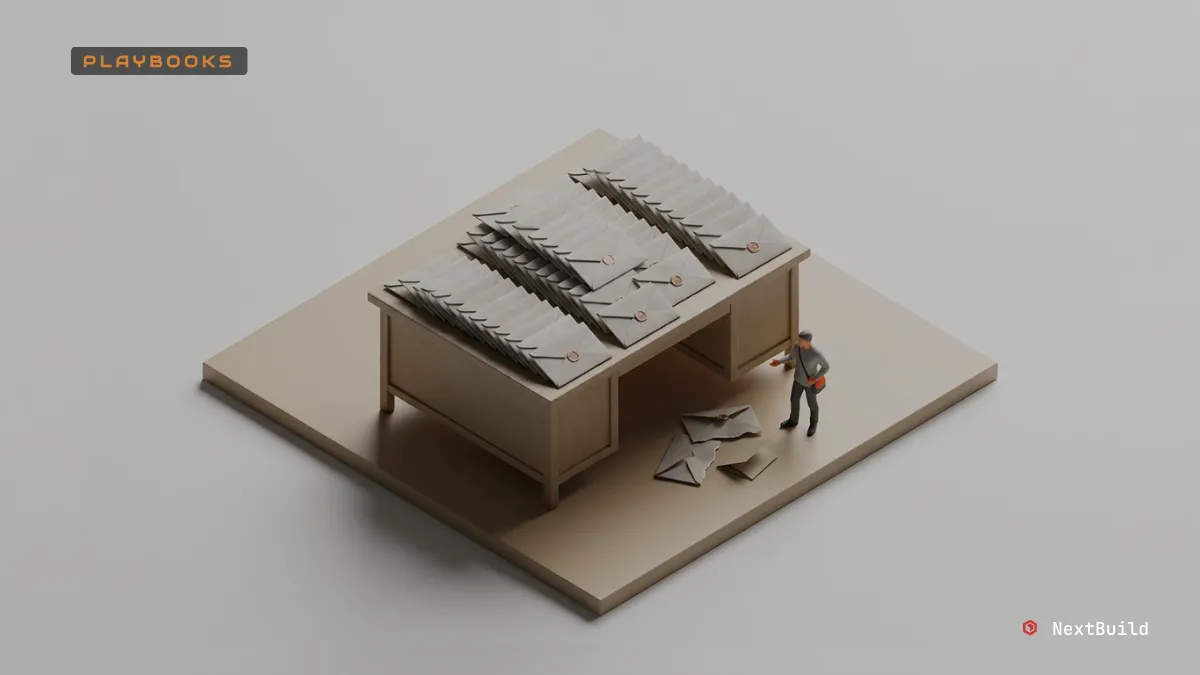
You think you have a sales problem. You don’t. You have a positioning problem wearing a sales costume.
Here’s how it shows up. You can build the thing. You’ve spent weekends wiring up agents, writing prompts, stitching APIs together. Now you’re staring at LinkedIn wondering why nobody’s biting, and you’ve started Googling cold email templates and outreach cadences because clearly the issue is that you haven’t sent enough messages.
It isn’t. The issue is that you can’t finish this sentence: I help [specific person] solve [specific problem]. Until you can, no channel, script, or cadence will save you.
What positioning actually is
Positioning is the decision about who you serve and what you solve — made before you say a word to a prospect.
That’s it. Not a tagline. Not a brand story. Not a website headline you’ll tweak later. It’s the choice underneath all the marketing — a specific buyer paired with a specific, expensive problem you can credibly solve. Everything downstream (your offer, your pricing, your outreach, your delivery system) is just an expression of that choice.
When positioning is locked, sales gets quieter and more boring. You stop chasing. The right people start nodding within the first thirty seconds of a conversation because you described their situation back to them more clearly than they could.
The misdiagnosis
Most builders think they need better outreach. The reality is that better outreach pointed at no one in particular just produces faster silence.
Here’s the loop. You send fifty messages. You get two replies, both polite passes. You conclude you need a better hook, a better channel, a better sequence. You spend the next two weeks studying cold email frameworks. You send a hundred messages with the new approach. Same result.
The messages aren’t the problem. The problem is upstream — you’re trying to compress “I do AI things, what do you need?” into a hook, and no hook can carry that weight. A vague offer cannot be rescued by good copywriting. It can only be exposed by it.
The capabilities trap
“I can build chatbots” is a capability, not a business. The buyer doesn’t care.
This is the trap almost every technically capable builder falls into. You’ve spent months learning to build agents, automations, RAG pipelines, voice systems. So when somebody asks what you do, you describe what you can build. I do AI automations. I build custom GPTs. I set up agents for businesses.
None of that tells a buyer whether you’re for them. A capability describes what you can do. A position describes whose problem you solve. Buyers don’t shop for capabilities — they shop for outcomes inside their own context.
Compare:
“I build AI automations for businesses.”
“I help independent insurance agencies cut policy-renewal admin from six hours a week to under one, so the principal can spend that time on new business.”
Same underlying capability. The second one closes deals. The first one starts a polite conversation that goes nowhere because the buyer has to do all the translation work themselves — and they won’t.
The 5-minute diagnostic: positioning problem or sales problem?
Run this on your own business right now. Be honest. The whole thing takes five minutes.
Answer each prompt with a real, specific sentence. Vague answers count as “no.”
-
Who is your buyer? Not “small business owners.” Name a role, an industry, and a size. “Operations leads at 20-50 person SaaS companies” counts. “Businesses that want to use AI” does not.
-
What problem do you solve for them? Name the specific, expensive pain — the one they already have a budget line or workaround for. “Manual lead qualification eating 10+ hours of sales rep time per week” counts. “Inefficiency” does not.
-
Why do they care right now? Name the trigger. New hire? Lost a person? Missed a quarter? “Just lost their ops manager and can’t justify backfilling” counts. “They want to be more efficient” does not.
-
Can you describe their situation back to them more clearly than they can? If you walked into a room of ten of them and described their week, would they nod or look confused?
-
Have you talked to at least five of them in the last 30 days? Conversations, not LinkedIn views.
Now score yourself:
-
Three or more vague answers: You have a positioning problem. Stop outreach. No channel, script, or sequence will fix this. The work is to pick a buyer and a problem and live with that choice long enough to test it.
-
All five specific, but no conversations or replies: You have a sales problem. Now we can talk about channels, offers, and outreach.
-
All five specific and you’re getting conversations but no closes: You have a delivery or pricing problem — different article.
Most builders who think they’re in bucket two are actually in bucket one. The specificity test is harder than it looks.
One edge case worth naming: if you’ve already tried a position, ran it for a few weeks, and it didn’t land — that is not automatic proof the position was wrong. Re-run the diagnostic on the position itself, not on the outreach numbers. Most “failed” positions were either too broad on the buyer (you picked an industry, not a role and a size), too soft on the problem (you named a category instead of a quantified pain), or under-tested (fewer than five real conversations with real buyers in that segment). Tighten one of those three before you scrap the position and start over.
What locked positioning looks like
Locked positioning is one sentence that names a specific buyer and a specific problem, and it doesn’t change when nobody’s looking.
A few examples of the shape — not to copy, but to calibrate:
“I help solo financial advisors with $50M-$150M AUM automate their quarterly client review prep so they can take on 30% more clients without hiring.”
“I help independent law firms (5-15 attorneys) cut intake-call screening time in half using an AI receptionist that books only qualified consults.”
“I help boutique e-commerce brands doing $2M-$10M cut their customer-service response time from 18 hours to under 30 minutes without adding headcount.”
Notice what’s there: a real buyer (size, role, vertical), a real problem (one they can name and quantify), and a real outcome. Notice what’s not there: the words “AI” or “automation.” The technology is invisible because the buyer doesn’t buy technology — they buy the outcome.
You’ll know your positioning is locked when three things are true: you can say it without flinching, you can repeat it identically a week later, and you stop wanting to change it every time a new buyer says no.
The one line
You cannot out-market a vague offer. You can only out-market a clear one badly.
That’s the whole article in a sentence. If your positioning is sharp, mediocre outreach still produces meetings. If your positioning is mush, brilliant outreach produces silence.
Step one, not step five
Positioning is the first thing to lock, not the last thing to polish.
Once it’s locked, the rest of the work gets dramatically easier. Channels become obvious — you go where your buyer already is. Outreach becomes specific — you can describe their situation back to them and they reply because it sounds like you’ve been reading their inbox. Pricing becomes defensible because you’re solving a problem with a known cost. Delivery becomes designable because you’re solving one problem for one type of buyer, not whatever shows up.
None of that works in reverse. You cannot pick a channel first and back into a position. You cannot write outreach first and discover your buyer through reply rates. The decision has to come first because every downstream decision depends on it.
So if you ran the diagnostic and landed in the positioning bucket, here’s the next move: stop outreach this week. Pick one buyer and one problem. Talk to five of them — not pitch, talk. Come back to your one-sentence positioning and rewrite it with what you heard. Do that loop until the sentence stops changing.
That’s the work. It’s quieter than sales work. It feels less productive because you’re not sending messages or watching open rates. But it’s the difference between a business that compounds and a year of polite rejections.
This is the first thing we lock with operators in the NextBuild cohort, before any outreach, channel, or system work — because every other decision is downstream of it, and we’ve watched too many capable builders waste good months trying to skip it. If you’re a capable builder tired of trading good months for polite rejections, join us in the next NextBuild cohort and lock the decision everything else depends on — with operators doing the same work beside you.